what was the event that caused texas to secede
/https://tf-cmsv2-smithsonianmag-media.s3.amazonaws.com/filer/b1/53/b15345ab-49dc-4c9c-a5f0-bdbfecb3d81f/de_cordova-tx-1851-03.jpg)
Earlier Saint John the Apostle Poof Garner became Franklin Roosevelt's vice president, and before he declared the task "isn't worth a mound of warm spit," the moo-cow-punching, whiskey-drinking, poker-dealing Texas congressman pushed a programme to grab even more clout for his already large state. Across his life history, as a turn-of-the century Texas State legislator and in interviews given during his time in Congress and on the occasion of his 1932 ascension to Speaker of the House, "Cactus Knave" argued that Texas could, and should, disunited itself into five states.
"An area twice as large and rapidly flattering as populous as Radical England should have at the least ten Senators," Garner told The New York Times in Apr 1921, "and the only way we can get them is to make water Little Phoeb States, not five small States, mind you, but fin great States." Thanks to the terms of Texas' 1845 admission to the Union, he argued, the state could split anytime, without any action from Congress—a power no other state has.
Gather up's idea went nowhere. But the representative from Uvalde, in the Hill Country west of San Antonio, was carrying on a long West Texas tradition of nerve-wracking to turn the Lone Star State into a constellation. Dividing Texas into galore micro Texases was gravely considered at the time Texas became a state and for decades later o. The thought survives today as a quirk in American law, a remnant of Texas' brief history atomic number 3 an independent land. It's also a peculiar part of Texas' identity as a state so big, it could split itself up—even though it loves its personal largeness overmuch to act up it.
"We're the exclusively state that can divide ourselves without anybody's permit," says Donald W. Whisenhunt, a Texas indigen and author of the 1987 Christian Bible The V States of Texas: An Immodest Proposal. "That's just the way it is."
Article Quaternary, Section 3, of the U.S. Constitution states that Congress must approve whatsoever new states. But Texas' title to an exception comes neat from the 1845 joint legislative resolution admitting Lone-Star State into the Union. It reads: "New States of convenient size not exceeding four in figure, in accession to said State of Texas and having sufficient population, English hawthorn, hereafter aside the consent of said State, be formed out of the territory thereof, which shall represent entitled to admission price under the provisions of the Federal Constitution." Supporters of Texas variance say this means that Congress pre-sanctioned a breakup.
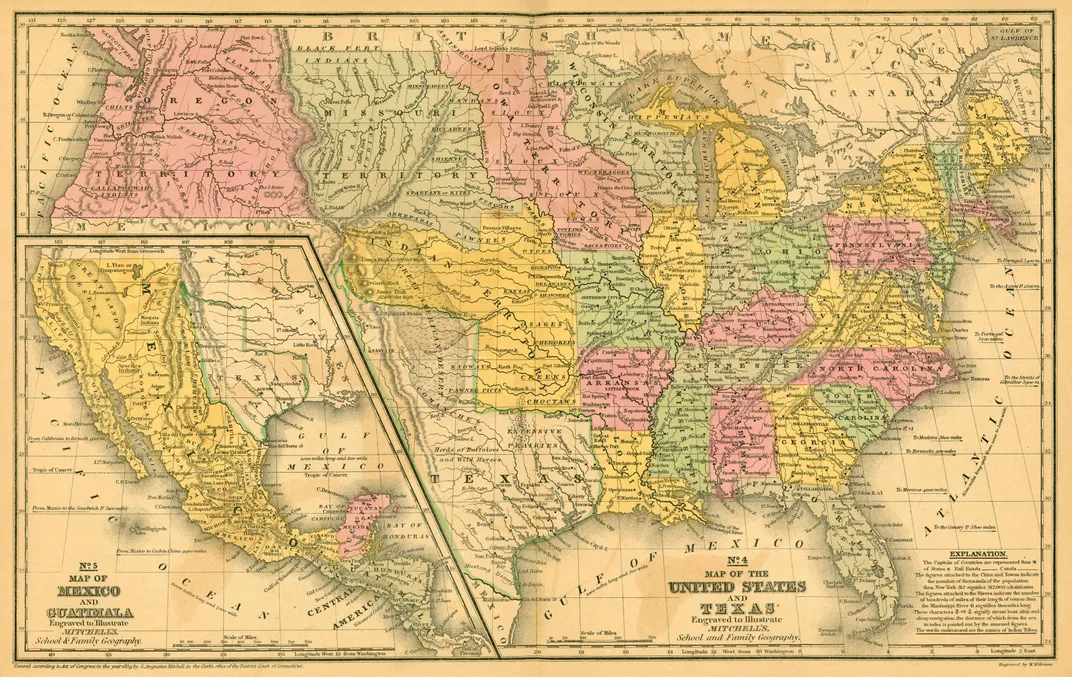
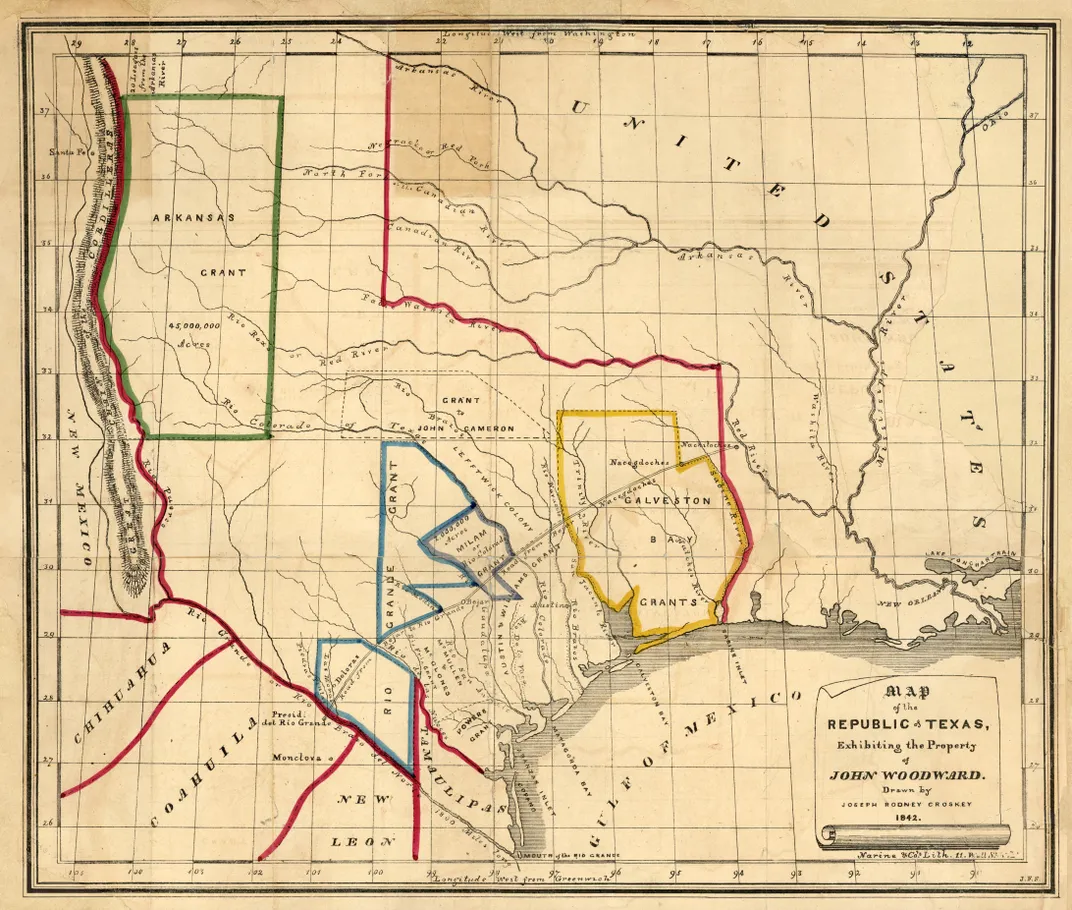
Slaveholding, and the tense power Balance between North and South in the 1840s, explains the clause. When TX married the United States after niner years as an independent republic, IT claimed even more territory than the 268,580 square up miles it covers today. Information technology laid claim to half of present-day Early Mexico and a weird stovepipe of bring, formed in part away the Rio Grande and A rivers, that reached north to what's now central Colorado and bits of Oklahoma, Kansas and even Wyoming. That northern tip poked above the 1820 Missouri River Compromise line, which did not allow thralldom north of parallel 36 degrees, 30 minutes.
How would such a giant piece of the Due west embody divided? In earliest 1845, when Congress debated Texas' admission, Northern congressmen wanted to divide Texas in half, splitting the state of matter in half diagonally, from the sea-coast eastmost of Corpus Christi up to the state's northwest corner, with Capital of Texa just to the easterly and San Antonio to the westerly. Slavery would be prohibited in thinly populated Westmost Texas, where many anti-slaveholding Germans had already settled.
But Southerners rejected that proposal as excessively restrictive of slavery. Instead, Isaac Van Zandt, the Texas republic's top diplomatist in Washington, pushed the four-new-states clause as a Confederate-friendly alternative. "Van Zandt…became very intimate with the Senators and Representatives from the Confederate states," wrote Weston Joseph McConnell in the 1925 BookSocial Cleavages in Texas. Van Zandt, like the Southerners, thought splitting Texas into a radical of states would give the South Sir Thomas More power. Texas' admission charge to the Union, with the new-states clause included, passed Congress 120-98. The only concession to the North: Slavery would comprise impermissible in any states formed north of the MO Via media line.
In 1847, Van Zandt ran for governor of Texas, bright to divide information technology into A many as four states. Dividing the state would give Texas more power in Washington, Van Zandt argued. He also thought that Texas, with its miniscule settlements hundreds of miles isolated, couldn't personify governed efficiently. (Devising himself regulator of a little res publica didn't seem to gravel New wave Zandt, evidently.) Texas historians tend to think Van Zandt would likely have won and divorce the state, if He hadn't died of yellow fever a month before the election.
When Congress redrew Texas' northern and western borders arsenic part of the Compromise of 1850, paying TX $10 million for what became eastern New Mexico and pieces of four other states, the statute included a line that preserved the young-states clause. But a proposition to split Texas into two states at the Brazos River failed in the state legislature, 33-15, in 1852. Most of its supporters came from east of the Brazos, another example of the widespread grievances between east and due west Texas. Each accused the other of incompetence and neglect. But that quarrel lost unsuccessful to Texans' pride in their shared account. "Which State would yield the emblem of a concentrated star?" asked theTexas State Gazette. "World Health Organization will hand up the blood-stained walls of the Alamo?"
Texas again came close to breaking up during Reconstructive memory. Radical Republicans, electoral at a metre when most former Confederates couldn't vote, tried to carve up Texas at its built-in conventionalism of 1868-1869. Their stated aim was to produce a Conglutination-informal West Texas that might rejoin the U.S. sooner than the rest of the state; critics argued they were really trying to produce many state offices for themselves. Pro-division delegates were a majority at the convention, but they couldn't fit in on a map—a revenant hurdle for Texas divisionism in the early years. "It's impossible to get Texans, cantankerous as they are, to gibe on a plan," Whisenhunt says.
Stymied Revolutionary Republicans wrote a "Constitution of the United States Department of State of West Texas," which promised civil rights for blacks while proposing to deny the vote to exwife-rebels, Ku Klux Klan members, and newspaper editors and ministers who'd supported the Confederacy. (That provocative and potentially unconstitutional estimation reflected Reconstruction debates about restoring X-Confederates' rights and citizenship.) But public opinion stood in opposition to their plan. Pro-class meetings attracted fewer people. Nearly all newspaper publisher in the state rejected the idea. Some mocked the estimation of creating a state in sparsely populated West Texas past suggesting alternate names: "The State of Prickley-Pear (Cactaea)," or "The State of Coyote."
Thwarted, the radicals appealed to Ulysses S. Grant, president-elect and commanding general of the Army, to intercede. He didn't. "Unrivalled Texas was amply sufficient to have available for the present," Grant told a reporter.
Lone-Star State never came close to dividing after that, though West Texas' coyotes howled about leaving when they felt neglected. They threatened to break up the state in April 1921 after Governor Dab M. Neff vetoed a bill to construct a college in West Texas. The Same day as the veto, 5,000 angry Cicily Isabel Fairfield Texans met in the town of Sweetwater and drafted resolutions calling for a breakup unless the legislature redistricted the posit and built the college. Their menace Crataegus laevigata rich person inspired Granary's partitioning talk withThe New York Multiplication later that month.
"For the next three years westward Texans assumed a militant attitude both in and out of the legislative assembly," wrote Ernest Edgar Wallace in his 1979 bookThe Howling of the Coyotes. The general assembly established Texas Discipline College, now Lone-Star State Technical school University, in Lubbock in 1923. "This token appeasement quieted the division sentiment," Wallace wrote.
In 1930, Garner brought up division again, out of anger at Copulation for passing the Smoot-Hawley tariff. "Texas would make 220 States the size of Rhode Island, 54 the size of Connecticut, six the size of it of New House of York," argued Garner, still hoping a divided Texas could outvote the Yankees.
Earn was the last prominent politician to support Texas division, but the theme still lives on as a what-if in political junkies' obsessive blue-red represent-gaming. In 2009, Nate Silver of FiveThirtyEight drew up a fantasy five-way split that created ternion Republican mini-Texases, a blue put forward along the Rio Grande, and a swing state around Austin. "Let's Mess With TX," a 2004Texas Law of nature Review wallpaper, argued that wily Texas Republicans could habituate the 1845 new-states article to gerrymander their way to Eight more U.S. Senate seats and Electoral College votes. A response from Ralph H. Brock, a former State Bar of Texas director, argued that the new-states clause would violate the Supreme Court of the United States's equal-footing doctrine.
The idea that Texas could carve up and grab ogdoad more Senate seats appeals to Texans' self-image as a unique, sprawling, powerful state. But that same sense of self volition prevent Texans from ever actually trying it.
"It's a novel musical theme that they might like at first glimpse," Whisenhunt says. But 30 years after he wrote his Christian Bible encouraging Texas division, helium's now confident it's fundamentally impossible. How to divide Texas' oil wealth, which funds its major state universities? Besides, Whisenhunt, 78, recalls the wounding to the Texas psyche when Alaska displaced it as the largest express in 1959. "There's a strengthened amount of pride in being the biggest, the best, and the first," He says.
what was the event that caused texas to secede
Source: https://www.smithsonianmag.com/history/more-150-years-texas-has-had-power-secede-itself-180962354/

Posting Komentar untuk "what was the event that caused texas to secede"